
Custer County District Court Role
Colorado uses a unified state trial-court system. District Courts are the general-jurisdiction trial courts, while County Courts handle limited civil, misdemeanor, traffic, small claims, felony complaint, and protection-order matters. Custer County sits in the 11th Judicial District with Chaffee, Fremont, and Park Counties. The official Custer County trial-court page identifies the local court as part of that district and lists one combined court location in Westcliffe.
The District Court side of Custer Combined Court handles the higher-impact case types. Felony criminal files, domestic relations, divorce, child custody, probate, juvenile, mental health, larger civil disputes, and appeals from County Court route through District Court. County Court remains important for traffic, misdemeanors, lower-dollar civil cases, and small claims. The same clerk office may assist both, so the case type matters more than the building name.
Custer Combined Court
205 S. 6th St.
PO Box 60
Westcliffe, CO 81252
(719) 783-2274
Fax: 719-735-1706
Email: custercountyclerk@judicial.state.co.us
Custer County District Court List
Custer County does not have a list of separate numbered District Court courthouses in the research file. The official local court table instead points to a single combined court location, with District Court and County Court functions sharing the same address, phone, fax, and email. The table below keeps the required court inventory local and shows the real court offices and specialty routing identified in the research.
| Court or office | Type | Address | Phone or email |
|---|---|---|---|
| Custer County District Court | General-jurisdiction trial court | 205 S. 6th St., PO Box 60, Westcliffe, CO 81252 | (719) 783-2274; custercountyclerk@judicial.state.co.us |
| Custer County Court | Limited-jurisdiction trial court | 205 S. 6th St., PO Box 60, Westcliffe, CO 81252 | (719) 783-2274; custercountyclerk@judicial.state.co.us |
| Custer County Probation | Probation supervision | Second floor of courthouse, left | 719-269-0155 |
| Water Division 2 | Arkansas River Basin water court | Pueblo Combined Court, 501 N. Elizabeth St., Pueblo, CO 81003 | Water Court Specialist Michele Santistevan, 719-404-8832 |
Custer County District Court Comparison
The local court structure is easier to use when the record custodian is tied to the case type. District Court, County Court, Water Court, and any municipal court do not all hold the same files. A person checking a felony case should not start with a municipal clerk, and a person checking a town ordinance citation should not assume the state District Court docket is the only source.
| Issue | District Court | County Court | Municipal or agency path |
|---|---|---|---|
| Main role | General-jurisdiction trial court | Limited-jurisdiction county trial court | Local ordinance or administrative matters when a separate venue exists |
| Civil cases | Larger civil matters and appeals from County Court | Civil cases under the statewide county-court limit | Administrative agency hearings outside the judicial branch |
| Criminal cases | Felony criminal cases and later felony proceedings | Misdemeanors, traffic, and felony complaints before transfer | Municipal ordinance citations if a town operates a court |
| Family and probate | Divorce, custody, probate, juvenile, mental health | Not the main venue for divorce or probate | Not the court file custodian for District Court family cases |
| Records channel | Custer Combined Court and Judicial Branch request form | Custer Combined Court and Judicial Branch request form | Specific municipal or agency custodian |
Custer County District Case Flow
A case can move between court levels depending on its type. Some criminal matters start as felony complaints in County Court and move to District Court. County Court civil judgments may be appealed to District Court. Divorce, probate, juvenile, and felony trial files usually begin on the District Court side. Water-rights matters are a separate specialty path.
Felony flow: Felony complaint in County Court › transfer or bind over to District Court › arraignment › pretrial motions › plea or trial › disposition and sentencing › appeal if allowed.
Civil and family flow: Complaint or petition filed in District Court › response › orders and hearings › settlement, trial, or decree › judgment or final order › appeal route if available.
Water flow: Water application or objection › Water Division 2 review › referee or judge process › decree or order › Supreme Court review path where applicable.
Custer County District Court Records
District Court records can contain a wide range of documents. Felony files may include a complaint or information, minute orders, bond conditions, motions, disposition, sentence order, protection orders, and financial obligations. Domestic relations records may include divorce decrees, parenting plans, separation agreements, support orders, and petitions. Probate files may include letters, wills, trusts, applications, petitions, closing documents, claims, and date-of-death information.
The official record channel is the Colorado Judicial Record/Document Request Form. The form allows Custer County selection, case type selection, party names, filing year, date of birth, case number, and document categories. It also lets a requester ask for certified or exemplified copies. Juvenile, suppressed, confidential, probate, and protected records can require photo ID or may be redacted.
- Use the docket search for hearing dates and calendar checks.
- Use the record request form for copies of actual documents.
- Use Custer Combined Court for local case questions and payment arrangements.
- Use Water Division 2 for water-rights records, not ordinary civil record assumptions.
Custer County Judicial District
The 11th Judicial District includes Chaffee, Custer, Fremont, and Park Counties. Research identifies Judge Amanda Hunter as chief judge after an October 28, 2024 Colorado Judicial Branch announcement. The same district also uses regional prosecution and defense offices for criminal cases. The Custer County Attorney page states that criminal prosecutions are handled by the 11th Judicial District Attorney rather than by the county attorney.
The district attorney role is relevant to District Court because felony charges are prosecuted through the district attorney, while the court keeps the case file. Research also notes a November 4, 2024 Judicial Branch announcement naming Jeff Lindsey as Acting District Attorney after a prior vacancy. Because officeholders can change, current leadership should be checked with the official district attorney page before relying on a name in a filing or notice.
The assigned manifest image from the U.S. Attorney's Office for the District of Colorado is federal, so it belongs only in the federal distinction context rather than the local District Court chain.
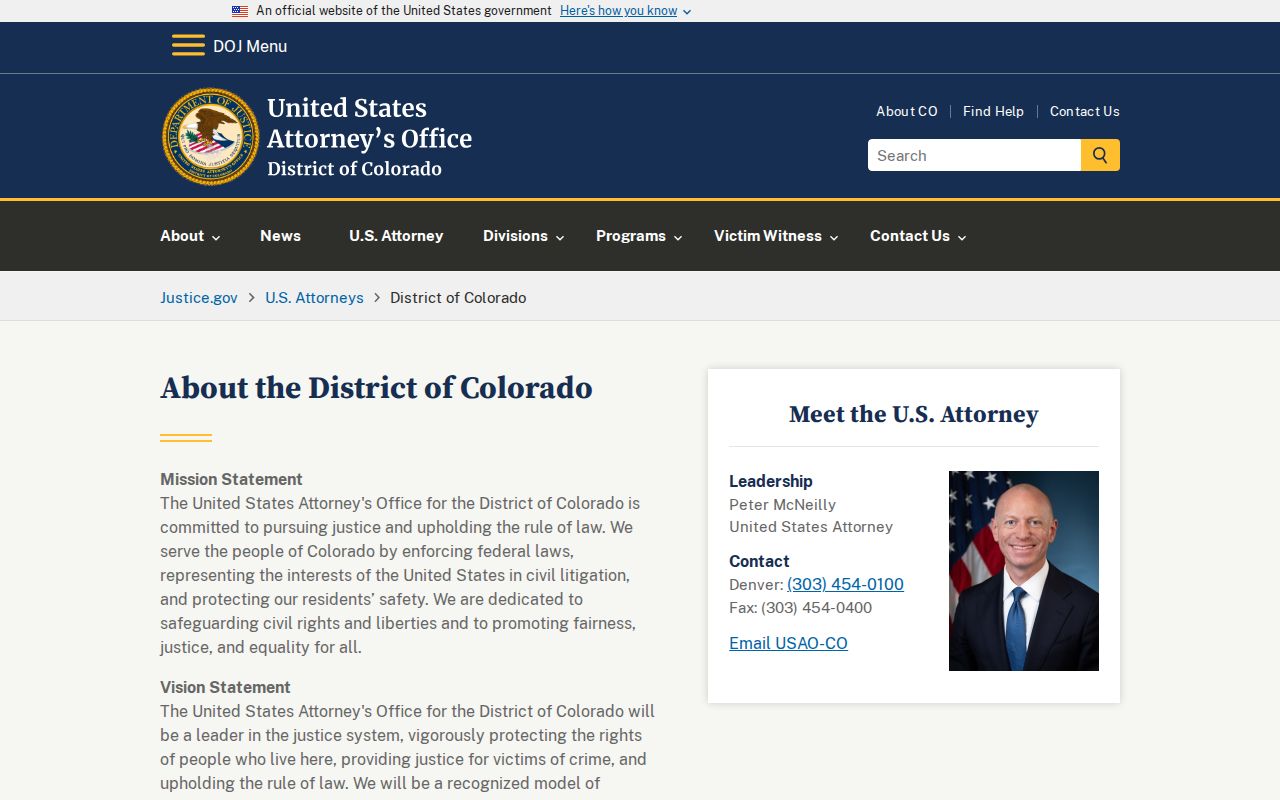
Federal prosecutors do not replace the 11th Judicial District Attorney in ordinary Custer County state felony cases. The filing court and prosecuting agency must match the case type.
Custer County Water Court Distinction
Colorado has specialized Water Courts as divisions of District Court for water matters. Custer County users with water-rights decrees, applications, objections, or Arkansas River Basin water issues should not assume a regular local civil case search captures the full record. Water Division 2 is the relevant Arkansas River Basin water division in the research file, based at Pueblo Combined Court.
Ordinary Custer County District Court records can help identify local trial-court filings, but water records deserve their own path because Colorado water cases have specialized rules and regional divisions. More detail is available through Custer County Water Court records.
Important: Water-rights matters are not ordinary Custer civil files; check Water Division 2 when the dispute involves water rights, decrees, or objections.
Custer County Federal Court Limits
Custer County is in the U.S. District Court for the District of Colorado for federal civil and criminal cases. Federal cases are not filed at Custer Combined Court and will not appear as ordinary Custer County District Court or County Court records. Federal bankruptcy matters route to the U.S. Bankruptcy Court for the District of Colorado, and appeals from the federal district court generally go to the U.S. Court of Appeals for the Tenth Circuit.
The District of Colorado PACER information page explains the federal electronic record system. The PACER court lookup page for CODC confirms the federal court identifier for the District of Colorado.
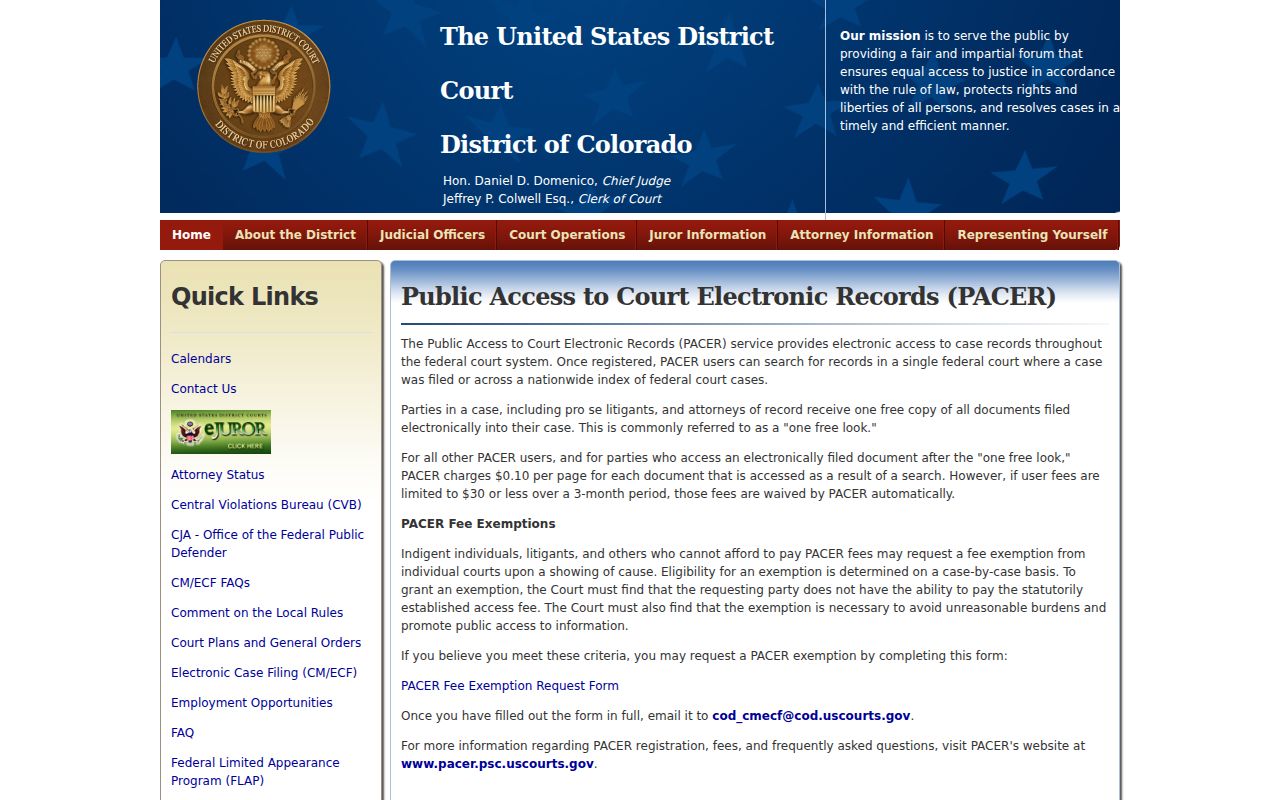
PACER is for federal docket and document access. It does not replace the Colorado Judicial record request form for Custer County state court files.
The federal lookup page from PACER court lookup is a second assigned image for the federal distinction.
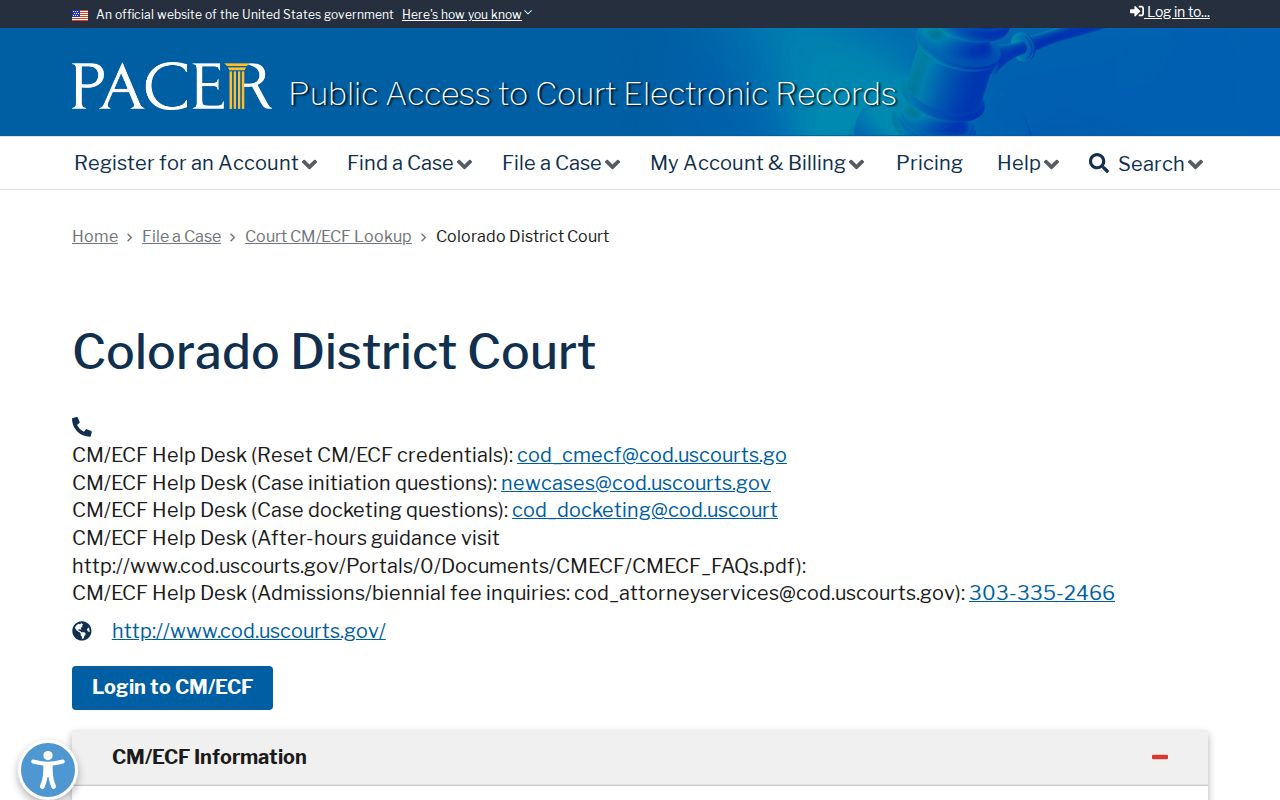
Use the federal lookup only when the case is a federal matter, such as a federal criminal prosecution, federal civil rights suit, federal agency case, diversity case, or habeas matter.
The assigned image from the U.S. Court of Appeals for the Tenth Circuit relates to federal appeals from Colorado federal district court.
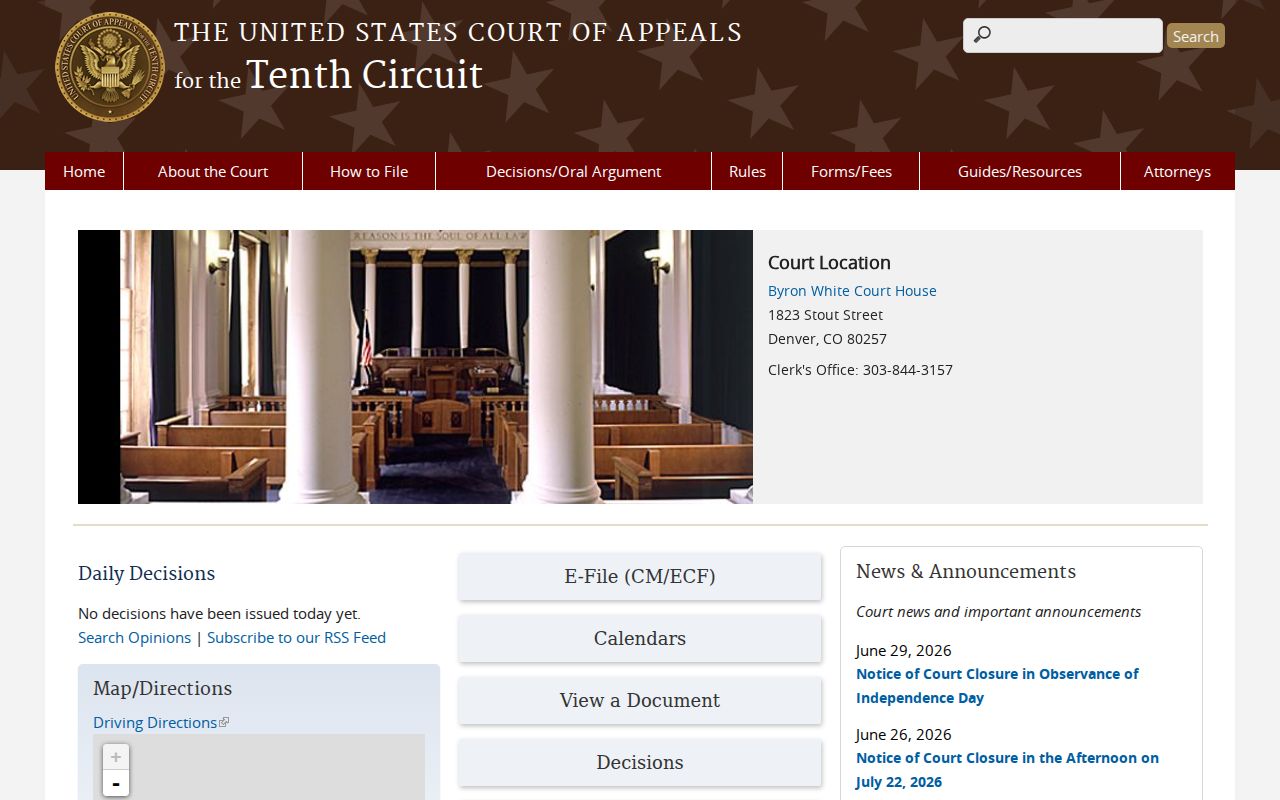
Colorado state appeals use Colorado appellate courts, while federal appeals from the District of Colorado use the Tenth Circuit. That distinction prevents a state District Court search from being sent to the wrong appellate system.