
Custer County Arrest Records and Charges
Custer County arrest records start on the law-enforcement side. They can involve the arresting agency, booking name, arrest date, alleged offense, bond question, custody status, or incident report if the sheriff can release it. The official Custer County Sheriff's Office did not expose a public online jail roster in the reviewed research, so arrest-record access is built around the sheriff phone line, the sheriff records/forms request path, VINELink custody checks, and court records once a charge is filed.
Court charge records begin when the prosecutor files the formal allegation in court. In Custer County, the county attorney page states that criminal prosecutions are handled by the 11th Judicial District Attorney, not by the county attorney. The charge record can appear as a complaint, information, summons, ticket, or felony complaint. The full case file, plea, disposition, and sentence belong in the Custer County criminal court records file, while the custody and jail-status side belongs with inmate records.
Find Custer County Arrest Records
There is no official Custer County public arrest-search portal in the reviewed sheriff pages. The official route starts with the Custer County Sheriff's Office for current custody, bond, incident, and releasable arrest-record questions. The sheriff records/forms page says CORA requests can be filed with the sheriff records request form, and the office provides help by phone or in person. For a person already charged in court, the state docket and court record request channels become the best way to track filed charges and later outcomes.
- Call the Sheriff's Office for current custody, bond, or whether the person is held locally or transferred.
- Use the sheriff records/forms page for releasable law-enforcement records when a written records request is needed.
- Check VINELink Colorado for custody notification when release or transfer status is the concern.
- Search the Colorado Judicial docket search for Custer County if charges may have been filed in court.
- Use the Judicial Branch record/document request form for a complaint, information, ticket, disposition, sentence order, or register of action.
This chain keeps arrest records and court charge records separate. Sheriff records can show law-enforcement activity if releasable. Court records show the filed charge, case status, disposition, and sentence after the prosecutor acts.
Charges After Arrest Documents
After an arrest, the prosecution decision controls what enters the court record. The arrest itself does not prove that the filed charge will match the first law-enforcement allegation. A prosecutor can file different charges, decline charges, amend charges, reduce charges, add counts, or dismiss counts later. The Custer County court record should be read from the charging document through the final disposition before drawing conclusions.
| Document | Who Files or Uses It | What It Does |
|---|---|---|
| Complaint | Officer or prosecutor, depending on matter and form | States allegations that can begin a criminal case or support an early court setting. |
| Information | Prosecutor | Formally lists charges, often in felony or prosecutor-filed criminal matters. |
| Indictment | Grand jury | Charges a case through grand jury action in serious or specialized matters. |
| Ticket or summons | Law enforcement or court process | Directs a person to appear on a traffic, petty, or misdemeanor-style allegation when used. |
Custer County Charge Status
Charge status changes as a case moves. The first charge list is not always the final charge list. A case can move from County Court to District Court, a count can be amended, a misdemeanor can resolve while a felony is dismissed, or a charge can be reduced as part of a plea. Each count should be checked for its own status and disposition.
| Status | What It Means |
|---|---|
| Pending | The charge is filed but no final outcome has been entered. |
| Amended | The charge text, code, level, or count changed from an earlier filing. |
| Reduced | The charge moved to a lower level or different offense, often through plea or prosecutor action. |
| Dismissed | The court record shows the charge was ended without a conviction on that count. |
| Disposition entered | The record has an outcome, such as guilty, not guilty, deferred, or another case result. |
| Sealed or suppressed | The charge or file may be hidden from public view under statute, rule, or court order. |
Custer County Charge vs Conviction
An arrest record and a court charge are not a conviction. A person can be arrested and never charged, charged and later dismissed, or convicted of a different charge than the one first filed. Public users should read the charge, the docket, and the disposition together. For a full case outcome, request the disposition or sentence order from the court rather than relying only on a charge list.
| Point | Charge | Conviction |
|---|---|---|
| Meaning | An allegation filed after arrest, citation, or prosecutor review. | A final criminal outcome based on plea, verdict, or qualifying court result. |
| Proof level | Filed accusation, not proof of guilt. | Result after the required legal process. |
| Document to request | Complaint, information, ticket, or register of action. | Disposition/sentence order or certified case record. |
| Common mistake | Treating every listed count as final. | Ignoring dismissed or amended earlier charges. |
Custer County Court Charge Routing
Custer County charges route through the court level that fits the case. County Court handles misdemeanors, traffic, felony complaints before transfer, protection orders, and lower civil matters. District Court handles felony criminal cases and larger trial-court matters. A felony can start with a County Court complaint and then move to District Court, so the docket and record request should be checked with that path in mind.
The official Custer court page lists the local court as part of the 11th Judicial District. It also provides the combined court contact details. That local court contact is the correct place for case-record and filing questions. The sheriff can answer custody and bond questions where releasable, but the court clerk controls court copies and case records.
Custer County Sheriff's Office
702 Rosita Ave.
PO Box 1489
Westcliffe, CO 81252
(719) 783-2270
Nonemergency dispatch: option 1
Custer Combined Court
205 S. 6th St.
PO Box 60
Westcliffe, CO 81252
(719) 783-2274
Email: custercountyclerk@judicial.state.co.us
Custer County Charge Codes
Charge codes tie the allegation to a statute, rule, ordinance, or traffic provision. The research identifies common court request categories rather than a free local charge-code database. A Custer County criminal request may use felony, misdemeanor, traffic, or related case codes, and the court record may show a complaint, information, ticket, disposition, sentence order, or register of action. One arrest can lead to several counts, and each count can have a different status.
A charge code should not be read apart from severity level and disposition. Felony charges are generally District Court matters. Misdemeanor and traffic allegations often start in County Court. Municipal citations, if any, may need a municipal court check. Water, probate, and civil records do not become criminal charge records simply because they appear in the same courthouse system.
Access Custer County Charge Records
Access rules depend on who holds the record. Sheriff arrest reports and booking records are criminal justice records handled through the sheriff records/forms route. Court charge records are judicial records handled by the Colorado Judicial Branch and Custer Combined Court. County administrative records are handled by county offices such as the Clerk & Recorder. The research identifies Colorado Open Records Act provisions, Criminal Justice Records Act provisions, and CJD 05-01 as the main frameworks.
For law-enforcement records, the Criminal Justice Records Act gives the custodian authority to make inspection rules and deny inspection where the law, court rule, court order, or public interest requires it. For court case records, the clerk can restrict juvenile, sealed, suppressed, protected, probate, personal identifier, victim, and confidential material. If a record is partly open, redactions may remove Social Security numbers, financial accounts, protected addresses, minor names, medical details, or victim information.
Note: A sheriff arrest record and a filed court charge can exist in separate systems with separate release rules.
Custer County Sealed Arrest Records
Colorado sealing does not always erase a record. The research notes that the Colorado Judicial Branch sealing guide explains sealed records remain available to criminal justice agencies, the court, and the district attorney, and may matter again if a person is later convicted. The Colorado Bureau of Investigation arrest-sealing source says a person may petition the court to seal records by filing in the District, County, or Municipal Court where the arrest or criminal case occurred.
| Point | Sealed | Expunged |
|---|---|---|
| Public access | Restricted from ordinary public view. | Removed or destroyed where a specific law allows. |
| Colorado adult records | Common relief term for many adult criminal records. | More limited and statute-specific. |
| Who may retain access | Courts, prosecutors, and criminal justice agencies may still have access. | Depends on the order and statute. |
| Custer starting point | Custer Combined Court for local state court cases, or municipal court for municipal matters. | Confirm eligibility before filing. |
Statewide Criminal History Limits
A statewide criminal history lookup is not the same as a Custer County charge record. The statewide result may be used for broader history, while the court charge record shows what was filed and what happened in a specific case. If the question is whether a Custer County charge was dismissed, reduced, or sentenced, the court record and disposition are more precise than a broad background-style result.
For current custody, VINELink Colorado and the sheriff phone line may help. For sentenced state-prison custody, the Colorado Department of Corrections inmate locator is separate from the county jail or court case. For sex offender status, the official Colorado registry is a separate statutory registry, not a general arrest-record search.
Custer County Charge Source
The Custer County Attorney page is the local source explaining that criminal prosecutions go to the Eleventh Judicial District Attorney.
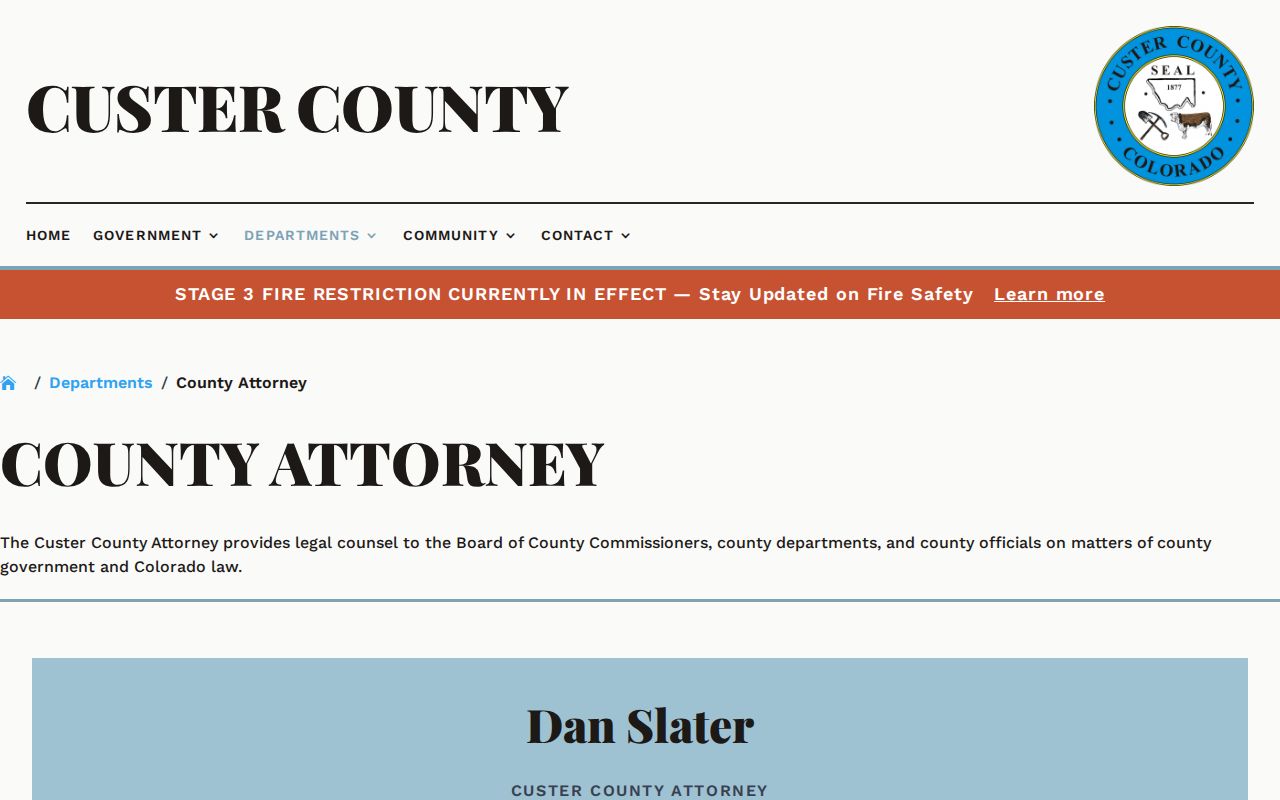
This image supports the charge-routing section because prosecutor responsibility is central to understanding court charges after arrest in Custer County.